New Framework Aims to Guide Psychiatric Neuromodulation and Brain Stimulation
Researchers have published a decision-making framework to help clinicians navigate various brain stimulation techniques for treatment-resistant psychiatric disorders.
 🧠Mind & Mental Health
Photo: Nature Health Sciences
Key points
- Researchers introduced a decision-making framework for psychiatric neuromodulation.
- The review synthesizes evidence on shared neural networks targeted by brain stimulation.
- Experts highlight a previous lack of direct comparative trials as a hurdle in clinical translation.
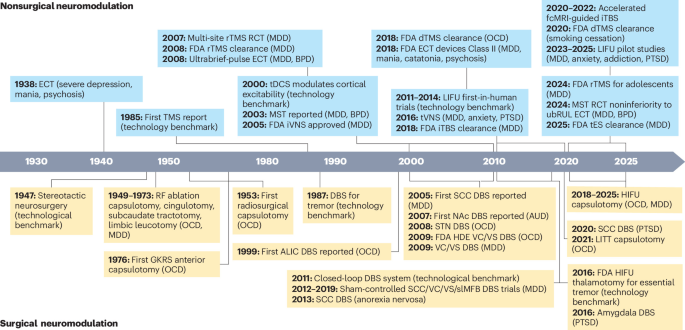
A team of researchers has outlined a comprehensive decision-making framework designed to help medical professionals select and combine different neuromodulation therapies for psychiatric disorders. Published in Nature Health Sciences, the perspective reviews how modern brain stimulation tools—ranging from transcranial magnetic stimulation and focused ultrasound to deep brain stimulation and therapeutic lesioning—can target dysfunctional brain circuits.
While clinical trials have demonstrated that these interventions can be both safe and effective for patients who have not responded to standard treatments, the field has lacked direct comparative trials and standardized criteria. The authors synthesized converging evidence showing that these various tools often engage shared neural networks to achieve symptom relief, creating an opportunity for more harmonized and circuit-based care.
What to know: The newly proposed model offers a structured approach to comparing and combining therapies, though it remains a high-level perspective rather than a rigid clinical protocol. Because brain stimulation technologies are rapidly evolving, patients considering these advanced interventions must consult qualified medical professionals to discuss personalized risks, benefits, and treatment options suited to their specific conditions.
Source Nature Health Sciences — nature.com/articles/s44220-026-00758-7 ↗
Read next
 ❤️Conditions & Care
Papua New Guinean Tree Compound Shows Potential in Motor Neuron Disease Study
Researchers at the University of Wollongong identified a natural compound from a rainforest tree that protected motor neurons against degeneration in laboratory tests.
 🔬Research
Virtual Reality Lowers Pain and Anxiety in Pediatric Emergency Care, Study Finds
A new systematic review and meta-analysis suggests that virtual reality technology can successfully decrease pain and anxiety for children undergoing procedures in hospit…
 🏥Public Health
New Parents with Intellectual Disabilities Face Significantly Higher Rates of Psychiatric Hospitalizations
Recent Australian research reveals that new parents with intellectual disabilities experience drastically elevated rates of emergency room visits and hospital admissions …
 🔬Research
Study Highlights Emotional, Social, and Spiritual Needs in Pediatric Palliative Care
A systematic review published in Palliative Medicine reveals that children receiving end-of-life care require psychological security, maintained social connections, and w…
 🔬Research
Type 2 Diabetes Linked to a 53% Higher Risk of Alzheimer's Disease, Study Finds
A comprehensive meta-analysis led by Curtin University researchers indicates that individuals with type 2 diabetes face a substantially elevated relative risk of developi…
 🔬Research
Brain Imaging Reveals Shared Memory Network in Mild Cognitive Impairment
A new study reveals that diverse areas of cortical thinning in individuals with mild cognitive impairment map to a single shared memory network. Researchers also found th…