Study Evaluates Carbon Footprint of University Dental Clinic Operations in El Salvador
Researchers have published a pilot framework assessing carbon footprints across faculty, students, and patients at a university dental clinic in El Salvador, finding that secondary emissions account for the vast majority of the total environmental impact.
 🔬Research
Photo: Nature Health Sciences
Key points
- Pilot study assessed carbon footprints at a university dental clinic in El Salvador using 222 records across students, patients, and faculty.
- Secondary emissions accounted for approximately 99.99% of the total carbon footprint across all evaluated groups.
- Students exhibited the highest average total emissions, while faculty members showed the greatest individual variability.
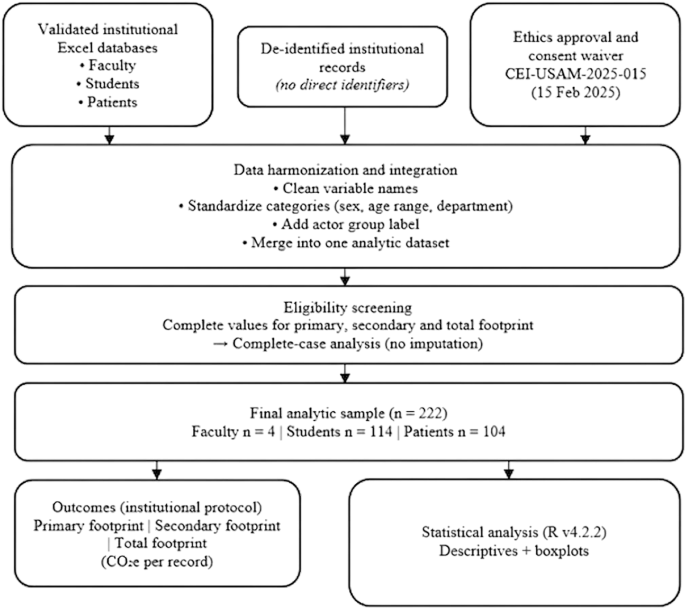
A recent cross-sectional study published in Nature Health Sciences has examined the environmental impact of dental care delivery by profiling carbon footprints at a university dental clinic in El Salvador. The investigation utilized validated multi-group databases comprising 222 total records, divided among 114 students, 104 patients, and four faculty members. By measuring primary, secondary, and overall carbon values expressed in kilograms of carbon dioxide equivalent per record, the authors sought to establish a replicable framework for evaluating institutional sustainability in low- and middle-income settings.
The findings indicate notable differences in carbon output across various stakeholder groups. Students registered the highest mean total carbon footprint at approximately 1,228.54 kg CO⁛e, followed by patients at an average of 920.01 kg CO⁛e. Faculty members demonstrated the lowest mean footprint at 846.23 kg CO⁛e, though their results showed the greatest variability, ranging widely from roughly 220.46 to 1,356.54 kg CO⁛e. Crucially, secondary emissions represented roughly 99.99% of total footprint values across all cohorts, pointing heavily toward system-level and operational protocols as major drivers of emissions.
As an observational pilot study with a small faculty sample size, the findings offer an initial baseline rather than definitive global standards. The authors note that while the proposed framework is scalable, broader implementation will require enhanced data granularity across different regional contexts. Readers interested in how institutional environmental policies intersect with healthcare should consult clinical administrators, and individuals should always discuss personal healthcare decisions with a qualified medical or dental professional.
What to know: A new study from El Salvador provides a baseline framework for measuring carbon emissions in university dental clinics, revealing that secondary operational factors drive the vast majority of the environmental footprint.
Source Nature Health Sciences — nature.com/articles/s41405-026-00505-1 ↗
Read next
 🏥Public Health
Preventive Services Task Force Resumes Meetings Under New Leadership
The U.S. Preventive Services Task Force is set to reconvene this week for the first time in over a year following a significant membership overhaul by Health Secretary Ro…
 ❤️Conditions & Care
Blood-Based Genetic Signature May Predict CAR T-Cell Therapy Success in Lymphoma
Researchers have identified a specific RNA signature in blood plasma that may help predict how well lymphoma patients respond to CAR T-cell therapy.
 🧠AI Analysis
Ultraprocessed Diets May Impact Brain Reward Systems in Younger Adults
A Virginia Tech study suggests that individuals aged 18 to 21 may experience changes in brain reward processing after consuming ultraprocessed foods, a response not obser…
 🧠Mind & Mental Health
Addressing Body Image and the Reality of Gluteal Anatomy
A personal reflection on the social and psychological impact of body shape, specifically regarding the gluteal region, and the limitations of consumer solutions for perce…
 ❤️Conditions & Care
Migraine and Smoking Linked to Increased Early Stroke Risk in Women
A large-scale study suggests that people who have given birth and experience migraines while also smoking face a significantly higher risk of stroke before age 60.
 🏃Fitness
Expert Advice on Hydration Gear Sparks Debate Among Recreational Runners
Olympic medalist Josh Kerr recently suggested that runners may not require hydration packs for distances under 12 miles, igniting a broader conversation about gear necess…