Forced Displacement Identified as Independent Driver of Health System Decline
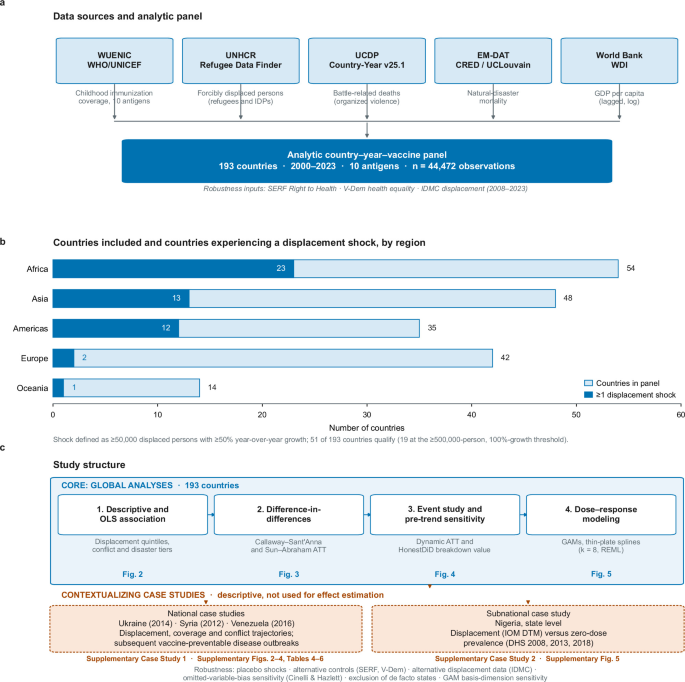
A global study of 193 countries reveals that the movement of displaced populations creates a distinct logistical shock to healthcare delivery, reducing vaccination rates by up to 6 percentage points.
 🔬Research
Photo: Nature Health Sciences
Key points
- Displacement causes a 3-6 percentage point drop in vaccination coverage.
- Health service disruption persists for 2-3 years after a displacement shock.
- The impact of displacement is independent of the direct effects of armed conflict and battle deaths.
Researchers analyzing data from 193 countries over two decades have found that forced displacement acts as a primary disruptor of healthcare services, independent of the violence that often causes it. The study, published in Nature Health Sciences, used childhood vaccination rates as a benchmark for health system performance between 2000 and 2023. It discovered that sudden surges in displaced populations are linked to a 3 to 6 percentage point decline in immunization coverage.
Long-term Impact and Logistical Strain
The data indicates that these disruptions are not temporary; the decline in service delivery typically persists for two to three years before the system begins to recover. The relationship appears nonlinear, meaning that while health systems may accommodate small demographic shifts, large-scale movements often breach logistical thresholds, causing a precipitous drop in service availability.
While armed conflict and battle-related deaths also negatively impact health services, the researchers noted that displacement creates a unique challenge. Unlike localized violence, which might destroy specific clinics, mass movement forces health administrators to track mobile populations across regions. This creates immense difficulty in reallocating finite resources under acute time constraints.
Study Scope and Limitations
The study also examined natural disasters but found no detectable association with national vaccination coverage declines in this specific dataset. While vaccination is a strong proxy for general health system performance, these findings are based on national-level data and may not capture every local nuance. The researchers suggest that displacement should be treated as a distinct, additive shock in humanitarian policy planning.
What to know: Forced displacement creates unique logistical pressures on health systems that are separate from the impacts of war. Always consult a healthcare professional regarding immunization schedules and personal health needs.
Source Nature Health Sciences — nature.com/articles/s41467-026-79274-2 ↗
Read next
 🧠Mind & Mental Health
Addressing Body Image and the Reality of Gluteal Anatomy
A personal reflection on the social and psychological impact of body shape, specifically regarding the gluteal region, and the limitations of consumer solutions for perce…
 ❤️Conditions & Care
Migraine and Smoking Linked to Increased Early Stroke Risk in Women
A large-scale study suggests that people who have given birth and experience migraines while also smoking face a significantly higher risk of stroke before age 60.
 🏃Fitness
Expert Advice on Hydration Gear Sparks Debate Among Recreational Runners
Olympic medalist Josh Kerr recently suggested that runners may not require hydration packs for distances under 12 miles, igniting a broader conversation about gear necess…
 🏃Fitness
A Structured Approach to Beginning a Strength and Cardio Routine
A new four-week training program offers beginners a guided path to incorporating strength training and cardiovascular exercise into their daily lives.
 🧠Mind & Mental Health
The Role of Daily Mobility Training in Managing Sedentary Tension
A two-week personal trial suggests that incorporating short, daily mobility exercises may help alleviate stiffness associated with sedentary desk work. Experts note that …
 🧠Mind & Mental Health
New Theoretical Framework Explores Memory Formation and Dementia
Researchers have proposed a new model suggesting the brain's limbic system functions similarly to generative AI, potentially offering a new way to understand and classify…