Switching to Subcutaneous Vedolizumab for IBD Maintenance: Real-World Outcomes
A retrospective study indicates that transitioning inflammatory bowel disease patients from intravenous to subcutaneous vedolizumab maintenance therapy is generally safe and maintains disease stability.
 🔬Research
Photo: Nature Health Sciences
Key points
- Transitioning to subcutaneous vedolizumab maintained stable disease activity in selected IBD patients.
- Treatment persistence was 71% at the 48-week mark in the study cohort.
- No serious systemic adverse events were documented, though some patients discontinued due to loss of response.
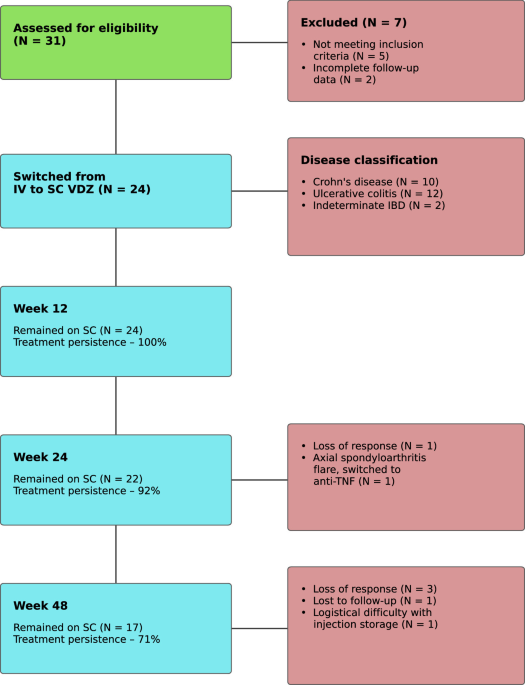
A recent retrospective study published in npj Autoimmunity examined the effectiveness and safety of switching patients with inflammatory bowel disease (IBD) from intravenous (IV) to subcutaneous (SC) vedolizumab maintenance therapy. The study followed 24 adults—including those with Crohn’s disease, ulcerative colitis, and indeterminate IBD—over a 48-week period. Researchers monitored clinical disease activity and biochemical markers, such as C-reactive protein and faecal calprotectin, at 12, 24, and 48 weeks.
Findings suggest that for patients already in remission at the time of the transition, the subcutaneous route provided stable disease control. While treatment persistence was 100% at week 12, it declined to 71% by week 48, with 29.2% of participants discontinuing the subcutaneous regimen, primarily due to a loss of response. No serious adverse events or systemic hypersensitivity reactions were reported, though one patient returned to IV therapy following an injection-site reaction.
What to know: This research was limited by a small sample size and its retrospective, single-centre design. While subcutaneous administration offers increased flexibility, patients should consult their gastroenterologist to determine if switching from intravenous infusions is appropriate for their specific clinical status.
Source Nature Health Sciences — nature.com/articles/s44483-026-00008-z ↗
Read next
 🏃Fitness
Understanding and Addressing Love Handles Through Lifestyle Changes
Experts clarify that spot reduction of fat is not physiologically possible, recommending a combination of calorie management and high-intensity interval training instead.
 🏃Fitness
Ciele Releases New Woolmark-Certified Merino Winter Running Apparel
Montreal-based brand Ciele has launched its second collection of merino wool running gear, featuring performance-focused fabrics designed for cold-weather training.
 🏥Public Health
Preventive Services Task Force Resumes Meetings Under New Leadership
The U.S. Preventive Services Task Force is set to reconvene this week for the first time in over a year following a significant membership overhaul by Health Secretary Ro…
 ❤️Conditions & Care
Blood-Based Genetic Signature May Predict CAR T-Cell Therapy Success in Lymphoma
Researchers have identified a specific RNA signature in blood plasma that may help predict how well lymphoma patients respond to CAR T-cell therapy.
 🧠AI Analysis
Ultraprocessed Diets May Impact Brain Reward Systems in Younger Adults
A Virginia Tech study suggests that individuals aged 18 to 21 may experience changes in brain reward processing after consuming ultraprocessed foods, a response not obser…
 🧠Mind & Mental Health
Addressing Body Image and the Reality of Gluteal Anatomy
A personal reflection on the social and psychological impact of body shape, specifically regarding the gluteal region, and the limitations of consumer solutions for perce…