Advanced Drug Delivery Systems Transform Modern Medicine Beyond Traditional Pills
A comprehensive review published in Nature Health Sciences examines the evolution of drug delivery technologies and their critical role in administering complex modern therapeutics.
 🏥Public Health
Photo: Nature Health Sciences
Key points
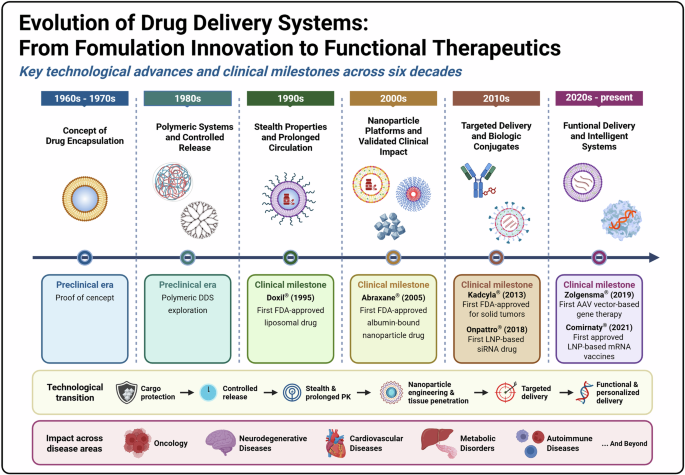
- Drug delivery systems have evolved from simple formulation aids to central determinants of modern therapy feasibility.
- Modern biologics and nucleic acids require sophisticated carriers like lipid nanoparticles and cellular systems to bypass biological barriers.
- Scaling these technologies requires overcoming persistent hurdles in manufacturing, safety, and clinical translation.
Modern medicine has shifted far beyond conventional small-molecule pills, increasingly relying on biologics, nucleic acids, and living medicines. According to a review published in Nature Health Sciences, this expansion has transformed drug delivery systems (DDS) from simple formulation aids into vital components that determine whether a therapy succeeds. As treatments become more complex, overcoming biological barriers like the blood-brain barrier and enzymatic degradation has become a central challenge in therapeutic design.
The review outlines a unified systems-level framework to categorize diverse delivery platforms—such as lipid nanoparticles, viral vectors, cellular carriers, and hydrogels—based on their carrier identity and targeting mechanisms. By aligning engineering principles with biological barriers at the systemic, cellular, and intracellular levels, the study offers a systematic approach to compare how different platforms perform across conditions like oncology, neurodegenerative diseases, and autoimmune disorders.
Despite significant technological advances, the clinical translation of these advanced delivery systems faces ongoing hurdles. Researchers note that shared bottlenecks in safety, manufacturing scalability, and biological complexity continue to limit broader clinical implementation. What to know: While these delivery platforms hold immense promise for precision medicine, they remain early-stage tools undergoing continuous evaluation. Readers should consult a healthcare professional for guidance regarding specific medical treatments and emerging therapies.
Source Nature Health Sciences — nature.com/articles/s41392-026-03086-5 ↗
Read next
 ❤️Conditions & Care
Blood-Based Genetic Signature May Predict CAR T-Cell Therapy Success in Lymphoma
Researchers have identified a specific RNA signature in blood plasma that may help predict how well lymphoma patients respond to CAR T-cell therapy.
 🧠AI Analysis
Ultraprocessed Diets May Impact Brain Reward Systems in Younger Adults
A Virginia Tech study suggests that individuals aged 18 to 21 may experience changes in brain reward processing after consuming ultraprocessed foods, a response not obser…
 🧠Mind & Mental Health
Addressing Body Image and the Reality of Gluteal Anatomy
A personal reflection on the social and psychological impact of body shape, specifically regarding the gluteal region, and the limitations of consumer solutions for perce…
 ❤️Conditions & Care
Migraine and Smoking Linked to Increased Early Stroke Risk in Women
A large-scale study suggests that people who have given birth and experience migraines while also smoking face a significantly higher risk of stroke before age 60.
 🔬Research
CBD Oil Found Ineffective for Managing Behavioral Issues in Youths with Intellectual Disabilities
A double-blind clinical trial published in JAMA Pediatrics indicates that CBD oil provides no significant behavioral improvement for children and teenagers with intellect…
 🏃Fitness
Expert Advice on Hydration Gear Sparks Debate Among Recreational Runners
Olympic medalist Josh Kerr recently suggested that runners may not require hydration packs for distances under 12 miles, igniting a broader conversation about gear necess…