New Research Links Excess Androgens to Insulin Resistance in Polyendocrine Metabolic Ovarian Syndrome
A recent study published in Nature Health Sciences reveals how high androgen levels drive fat tissue changes that may lead to insulin resistance in individuals with polyendocrine metabolic ovarian syndrome (PMOS).
 🥗Nutrition
Photo: Nature Health Sciences
Key points
- PMOS is associated with the expansion of a specific preadipocyte population, PreA2.
- NR4A1 acts as a driver of the androgen-associated acquisition of the PreA2 state.
- Reducing THBS1 partially restores insulin responsiveness in human adipocytes exposed to high androgens.
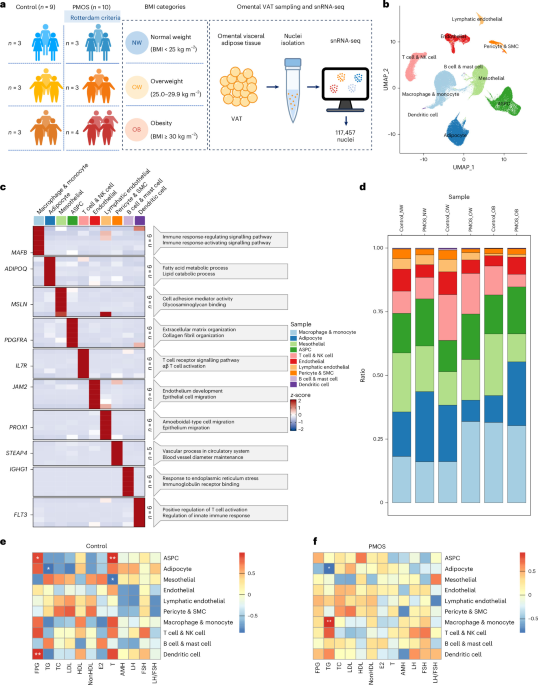
Researchers investigating the biological mechanisms behind polyendocrine metabolic ovarian syndrome (PMOS)—formerly known as polycystic ovary syndrome—have identified a cellular pathway that connects excess androgens to metabolic dysfunction. Using single-nucleus RNA sequencing on visceral adipose tissue from women with PMOS and body mass index-matched controls, a team of scientists mapped the cellular landscape of fat tissue across normal-weight, overweight, and obese groups.
The investigation showed that PMOS is linked to the expansion of a specific preadipocyte population called PreA2, which carries genetic risks tied to both reproductive and metabolic traits. Computational tools and primary cell experiments pointed to NR4A1 as a key driver that causes preadipocytes to acquire this state when exposed to high androgen levels. Further trajectory analysis highlighted a differentiation pathway leading from PreA2 cells to an adipocyte state designated as Ad3, marked by heightened secretion of THBS1. When human adipocytes exposed to elevated androgen concentrations underwent THBS1 knockdown, researchers observed a partial restoration of insulin responsiveness.
While these findings offer a detailed single-nucleus atlas of adipose tissue remodeling, the authors note that the study relies on tissue samples, computational modeling, and animal data from dihydrotestosterone-treated female mice. Readers should consult a qualified healthcare provider regarding personal medical decisions or chronic metabolic concerns.
What to know: Excess androgens in PMOS promote the expansion of a specific preadipocyte group, which differentiates into cells secreting THBS1 and contributing to insulin resistance.
Source Nature Health Sciences — nature.com/articles/s42255-026-01654-1 ↗
Read next
 🏥Public Health
Preventive Services Task Force Resumes Meetings Under New Leadership
The U.S. Preventive Services Task Force is set to reconvene this week for the first time in over a year following a significant membership overhaul by Health Secretary Ro…
 ❤️Conditions & Care
Blood-Based Genetic Signature May Predict CAR T-Cell Therapy Success in Lymphoma
Researchers have identified a specific RNA signature in blood plasma that may help predict how well lymphoma patients respond to CAR T-cell therapy.
 🧠AI Analysis
Ultraprocessed Diets May Impact Brain Reward Systems in Younger Adults
A Virginia Tech study suggests that individuals aged 18 to 21 may experience changes in brain reward processing after consuming ultraprocessed foods, a response not obser…
 🧠Mind & Mental Health
Addressing Body Image and the Reality of Gluteal Anatomy
A personal reflection on the social and psychological impact of body shape, specifically regarding the gluteal region, and the limitations of consumer solutions for perce…
 ❤️Conditions & Care
Migraine and Smoking Linked to Increased Early Stroke Risk in Women
A large-scale study suggests that people who have given birth and experience migraines while also smoking face a significantly higher risk of stroke before age 60.
 🔬Research
CBD Oil Found Ineffective for Managing Behavioral Issues in Youths with Intellectual Disabilities
A double-blind clinical trial published in JAMA Pediatrics indicates that CBD oil provides no significant behavioral improvement for children and teenagers with intellect…