New Review Highlights Epigenetic Factors in Inflammatory Bowel Disease
A recent review published in Nature Health Sciences explores how epigenetic regulation bridges genetic susceptibility and environmental factors in inflammatory bowel disease.
 ❤️Conditions & Care
Photo: Nature Health Sciences
Key points
- Review examines epigenetic regulation in inflammatory bowel disease
- DNA methylation patterns link environmental exposures to immune responses
- Findings suggest potential for disease stratification and therapy prediction
- Prospective clinical validation remains essential before widespread application
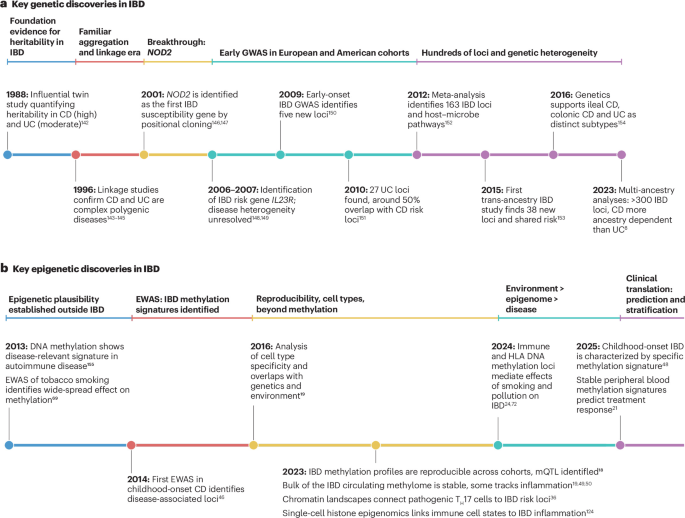
A comprehensive review published in Nature Health Sciences examines how epigenetic mechanisms may help explain the complex origins of inflammatory bowel disease (IBD). While genome-wide association studies have uncovered over 300 genetic risk loci, these common variants only partially account for disease liability and struggle to predict individual therapeutic outcomes or disease progression. To address these gaps, researchers highlight epigenetics as a key molecular bridge where genetic vulnerabilities and environmental exposures converge to alter gene regulation in both immune and epithelial compartments.
The authors synthesize data from various blood- and tissue-based methylation studies across pediatric, adult, and longitudinal cohorts. Findings suggest that reproducible DNA methylation patterns exist in IBD, reflecting stable regulatory states rather than temporary inflammatory responses. Blood-based methylation typically highlights systemic immune states, whereas mucosal profiles illustrate specific tissue challenges, such as epithelial barrier breakdown. However, the authors note that these insights rely heavily on observational data and current findings require broader prospective validation before routine clinical application.
Environmental exposures—including smoking habits, microbiome signals, and early-life experiences—appear to influence disease risk through these durable methylation adjustments. Although these frameworks offer promising avenues for patient stratification and predicting responses to certain biologic therapies, further technological integration using causal inference and single-cell approaches is necessary to refine clinical translation. Readers considering personalized strategies should consult qualified healthcare professionals for individual medical guidance.
Source Nature Health Sciences — nature.com/articles/s41575-026-01275-9 ↗
Read next
 🏃Fitness
Understanding and Addressing Love Handles Through Lifestyle Changes
Experts clarify that spot reduction of fat is not physiologically possible, recommending a combination of calorie management and high-intensity interval training instead.
 🏃Fitness
Ciele Releases New Woolmark-Certified Merino Winter Running Apparel
Montreal-based brand Ciele has launched its second collection of merino wool running gear, featuring performance-focused fabrics designed for cold-weather training.
 🏥Public Health
Preventive Services Task Force Resumes Meetings Under New Leadership
The U.S. Preventive Services Task Force is set to reconvene this week for the first time in over a year following a significant membership overhaul by Health Secretary Ro…
 🧠AI Analysis
Ultraprocessed Diets May Impact Brain Reward Systems in Younger Adults
A Virginia Tech study suggests that individuals aged 18 to 21 may experience changes in brain reward processing after consuming ultraprocessed foods, a response not obser…
 🧠Mind & Mental Health
Addressing Body Image and the Reality of Gluteal Anatomy
A personal reflection on the social and psychological impact of body shape, specifically regarding the gluteal region, and the limitations of consumer solutions for perce…
 🔬Research
CBD Oil Found Ineffective for Managing Behavioral Issues in Youths with Intellectual Disabilities
A double-blind clinical trial published in JAMA Pediatrics indicates that CBD oil provides no significant behavioral improvement for children and teenagers with intellect…