Combining Prostatic Lift and Radiotherapy Appears Safe for Prostate Cancer Patients With BPH
A phase I clinical trial suggests that using a prostatic urethral lift implant alongside stereotactic ablative body radiotherapy is a safe and feasible option for men dealing with both prostate cancer and benign prostatic hyperplasia.
 ❤️Conditions & Care
Photo: Nature Health Sciences
Key points
- Phase I clinical trial evaluated 15 patients with intermediate-risk prostate cancer and symptomatic BPH.
- Combined prostatic urethral lift (PUL) and stereotactic ablative body radiotherapy showed no severe (grade 3+) toxicities.
- Patients demonstrated significant improvements in urinary symptom scores at three months post-radiation.
Researchers evaluating a novel treatment strategy have found that combining a prostatic urethral lift (PUL) with stereotactic ablative body radiotherapy (SAbR) appears safe and feasible for men diagnosed with intermediate-risk prostate cancer and concurrent benign prostatic hyperplasia (BPH). Traditionally, patients with severe lower urinary tract symptoms from BPH are often ruled out for SAbR due to the heightened risk of worsening urinary complications from high-dose radiation.
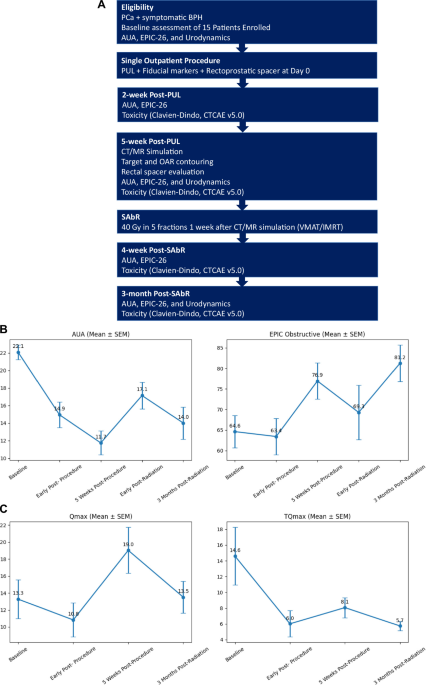
The single-arm phase I trial enrolled 15 participants who underwent a single general anesthesia procedure to receive the PUL implant, rectoprostatic spacer gel, and fiducial markers, followed by SAbR treatment. Investigators reported that four individuals experienced mild, grade 1-2 perioperative complications related to the PUL implantation, while eight patients experienced mild genitourinary adverse events during or after radiation. No severe toxicities of grade 3 or higher were observed among the group.
Furthermore, participants showed statistically significant improvements in urinary function following the intervention. The mean American Urological Association Symptom Score dropped from 22.1 down to 14.0 at three months post-radiation, and obstructive scores similarly improved. Experts note that while these findings are encouraging, the study was a small, non-blinded early-stage trial with a short three-month follow-up window, meaning larger randomized studies are needed to confirm long-term outcomes.
What to know: The early-stage trial of 15 patients indicates that mechanical retraction via a prostatic urethral lift may help clear men with BPH for SAbR prostate cancer treatment without severe side effects. Readers should always consult a qualified healthcare provider for personalized medical decisions and treatment options.
Source Nature Health Sciences — nature.com/articles/s41391-026-01169-6 ↗
Read next
 🏃Fitness
Understanding and Addressing Love Handles Through Lifestyle Changes
Experts clarify that spot reduction of fat is not physiologically possible, recommending a combination of calorie management and high-intensity interval training instead.
 🏃Fitness
Ciele Releases New Woolmark-Certified Merino Winter Running Apparel
Montreal-based brand Ciele has launched its second collection of merino wool running gear, featuring performance-focused fabrics designed for cold-weather training.
 🏥Public Health
Preventive Services Task Force Resumes Meetings Under New Leadership
The U.S. Preventive Services Task Force is set to reconvene this week for the first time in over a year following a significant membership overhaul by Health Secretary Ro…
 🧠AI Analysis
Ultraprocessed Diets May Impact Brain Reward Systems in Younger Adults
A Virginia Tech study suggests that individuals aged 18 to 21 may experience changes in brain reward processing after consuming ultraprocessed foods, a response not obser…
 🧠Mind & Mental Health
Addressing Body Image and the Reality of Gluteal Anatomy
A personal reflection on the social and psychological impact of body shape, specifically regarding the gluteal region, and the limitations of consumer solutions for perce…
 🔬Research
CBD Oil Found Ineffective for Managing Behavioral Issues in Youths with Intellectual Disabilities
A double-blind clinical trial published in JAMA Pediatrics indicates that CBD oil provides no significant behavioral improvement for children and teenagers with intellect…