New AI Framework Improves Localized Infectious Disease Forecasting
Researchers have developed an explainable machine learning model that integrates diverse data sources to better predict localized infectious disease outbreaks.
 🧠AI Analysis
Photo: Nature Health Sciences
Key points
- The STGCN-AG model integrates complex demographic and socioeconomic data to map disease risk.
- The framework demonstrated superior performance at short-term, 3-day forecasting intervals.
- Longer-term predictions remain difficult due to rapid changes in incidence and temporal lag.
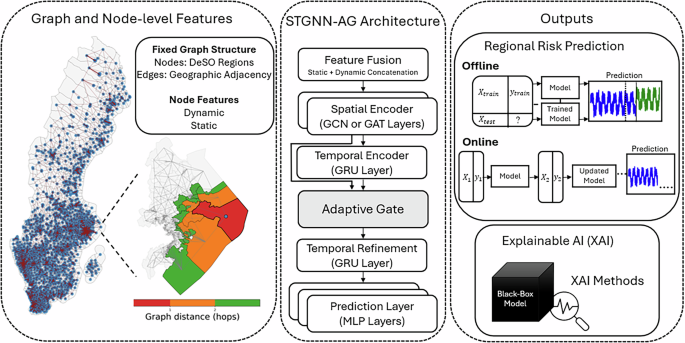
A new study published in npj Digital Public Health introduces an explainable spatiotemporal graph learning framework designed to improve the accuracy of localized infectious disease forecasting. By utilizing COVID-19 data from Sweden, the researchers created a model that synthesizes demographic, socioeconomic, and epidemiological information across fine-grained geographic areas. This approach employs an adaptive gating mechanism to modulate how spatial data is processed over time, allowing for more precise predictions of disease spread at the local level.
The research team evaluated their model, known as STGCN-AG, against traditional machine learning methods such as LSTM and tree-based models. Findings suggest that the new framework performs particularly well at shorter forecasting horizons, such as three days. However, the study also notes that all models faced challenges with longer-term predictions, as performance tended to decline when forecasting 14 to 21 days into the future.
What to know: While the model offers a more transparent way to track disease dynamics, it is not a replacement for clinical assessment. Predictive models remain sensitive to data quality and the speed of evolving outbreaks. Readers should consult public health authorities for official guidance on local health risks.
Source Nature Health Sciences — nature.com/articles/s44482-026-00046-2 ↗
Read next
 🧠Mind & Mental Health
Addressing Body Image and the Reality of Gluteal Anatomy
A personal reflection on the social and psychological impact of body shape, specifically regarding the gluteal region, and the limitations of consumer solutions for perce…
 ❤️Conditions & Care
Migraine and Smoking Linked to Increased Early Stroke Risk in Women
A large-scale study suggests that people who have given birth and experience migraines while also smoking face a significantly higher risk of stroke before age 60.
 🔬Research
CBD Oil Found Ineffective for Managing Behavioral Issues in Youths with Intellectual Disabilities
A double-blind clinical trial published in JAMA Pediatrics indicates that CBD oil provides no significant behavioral improvement for children and teenagers with intellect…
 🏃Fitness
Expert Advice on Hydration Gear Sparks Debate Among Recreational Runners
Olympic medalist Josh Kerr recently suggested that runners may not require hydration packs for distances under 12 miles, igniting a broader conversation about gear necess…
 🏃Fitness
A Structured Approach to Beginning a Strength and Cardio Routine
A new four-week training program offers beginners a guided path to incorporating strength training and cardiovascular exercise into their daily lives.
 🧠Mind & Mental Health
The Role of Daily Mobility Training in Managing Sedentary Tension
A two-week personal trial suggests that incorporating short, daily mobility exercises may help alleviate stiffness associated with sedentary desk work. Experts note that …