Biliary Bile Acid Profiles Show Promise in Early Diagnosis of Biliopancreatic Cancers
A recent study published in Nature Health Sciences reveals that profiling bile acids in the common bile duct may significantly improve the early detection and differentiation of pancreatic and bile duct cancers.
 🧠AI Analysis
Photo: Nature Health Sciences
Key points
- Bile acid profiles differ distinctly between pancreatic ductal adenocarcinoma and cholangiocarcinoma.
- Combined bile acid models outperformed conventional serum markers like CA19-9 and CEA in diagnostic accuracy.
- Data were derived from prospective bile sampling during standard endoscopic procedures.
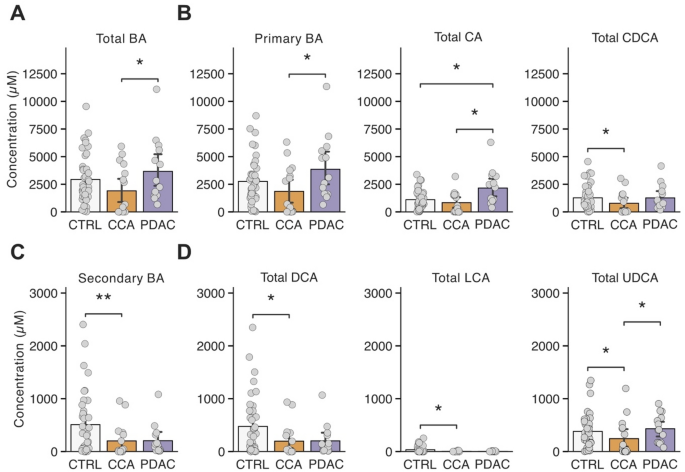
Researchers investigating aggressive biliopancreatic malignancies—specifically cholangiocarcinoma and pancreatic ductal adenocarcinoma—have identified distinct metabolic signatures in human bile samples that could enhance diagnostic accuracy. Because current blood-based markers and tissue sampling techniques frequently lack sensitivity for indeterminate strictures, investigators analyzed biliary fluid to uncover disease-specific alterations within the local microenvironment.
Evaluating Diagnostic Performance
The prospective investigation evaluated 71 individuals, comprising 41 noncancer controls, 14 patients with pancreatic ductal adenocarcinoma, and 16 patients with cholangiocarcinoma. Utilizing ultra-performance liquid chromatography coupled with tandem mass spectrometry alongside advanced machine learning algorithms, the team identified specific bile acid signatures. After adjusting for clinical variables such as bilirubin and alkaline phosphatase, a combined model featuring glycocholic acid, taurochenodeoxycholic acid, and taurohyocholic acid achieved a cross-validated area under the curve of 0.85, outperforming traditional serum markers like CA19-9 and CEA.
Clinical Implications and Limitations
What to know: While these findings suggest that molecular analysis of bile collected during endoscopic retrograde cholangiopancreatography may complement conventional diagnostic evaluations, the study relies on a relatively small, single-center cohort. Patients should always consult qualified healthcare professionals for personal medical decisions and specialized diagnostic procedures.
Bile acid signatures identified after adjustment for cholestasis may complement conventional serum biomarkers during routine clinical evaluations.
Source Nature Health Sciences — nature.com/articles/s41598-026-80428-x ↗
Read next
 🏥Public Health
Preventive Services Task Force Resumes Meetings Under New Leadership
The U.S. Preventive Services Task Force is set to reconvene this week for the first time in over a year following a significant membership overhaul by Health Secretary Ro…
 ❤️Conditions & Care
Blood-Based Genetic Signature May Predict CAR T-Cell Therapy Success in Lymphoma
Researchers have identified a specific RNA signature in blood plasma that may help predict how well lymphoma patients respond to CAR T-cell therapy.
 🧠Mind & Mental Health
Addressing Body Image and the Reality of Gluteal Anatomy
A personal reflection on the social and psychological impact of body shape, specifically regarding the gluteal region, and the limitations of consumer solutions for perce…
 ❤️Conditions & Care
Migraine and Smoking Linked to Increased Early Stroke Risk in Women
A large-scale study suggests that people who have given birth and experience migraines while also smoking face a significantly higher risk of stroke before age 60.
 🔬Research
CBD Oil Found Ineffective for Managing Behavioral Issues in Youths with Intellectual Disabilities
A double-blind clinical trial published in JAMA Pediatrics indicates that CBD oil provides no significant behavioral improvement for children and teenagers with intellect…
 🏃Fitness
Expert Advice on Hydration Gear Sparks Debate Among Recreational Runners
Olympic medalist Josh Kerr recently suggested that runners may not require hydration packs for distances under 12 miles, igniting a broader conversation about gear necess…