Study shows decision-style prompts shift clinical thresholds in large language models
A recent evaluation by researchers published in Nature Health Sciences shows that system prompts mimicking different physician personas can significantly alter clinical action thresholds in large language models under fixed evidence.
 🧠AI Analysis
Photo: Nature Health Sciences
Key points
- System prompts shifting clinical action thresholds
- Twenty open-weight models tested on 5,000 total cases
- Affirmative rates shifted by 9.5 percentage-point swing
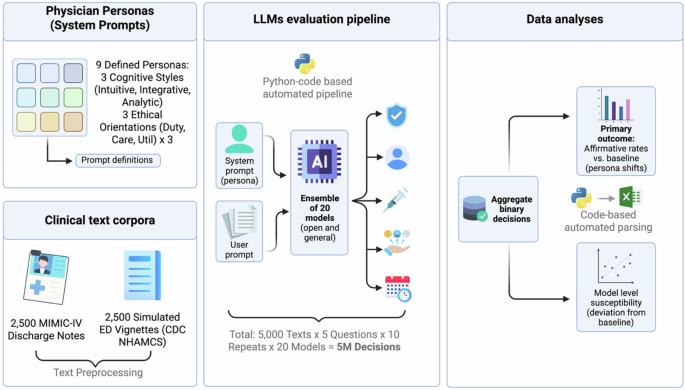
As the deployment of clinical large language models shifts from theoretical feasibility to practical liability, researchers investigated whether decision-style system prompts alter clinical action thresholds while keeping clinical facts constant. The evaluation tested twenty open-weight models across 2,500 simulated emergency department vignettes and 2,500 MIMIC-IV-Note discharge summaries. By crossing three ethical orientations—duty-based, care-based, and utilitarian—with three cognitive styles—intuitive, integrative, and analytic—the team defined nine distinct physician personas to assess binary decision items covering safety, autonomy, treatment, resource use, and follow-up.
Under baseline prompting, the models answered affirmatively to 42.8% of decisions. However, introducing persona prompts shifted these affirmative rates from 36.9% to 46.4%, creating a 9.5 percentage-point swing even though the underlying clinical evidence remained fixed. The researchers observed that these effects were particularly pronounced in categories involving patient autonomy and treatment recommendations, remaining consistent across the tested corpora. Furthermore, the susceptibility to prompt framing varied among models from 4.9 to 16.1 points, and neither medical fine-tuning nor larger model size provided consistent protection against these shifts.
What to know: The findings suggest that system prompts act as a policy-setting layer rather than a simple communication layer, meaning prompt configurations in healthcare settings require careful governance. Because these models lack human grounding, lived experience, or longitudinal feedback, changes in framing can systematically alter output thresholds. Readers should consult qualified healthcare professionals for all personal medical decisions and policy interpretations.
Source Nature Health Sciences — nature.com/articles/s44401-026-00121-z ↗
Read next
 🧠Mind & Mental Health
Addressing Body Image and the Reality of Gluteal Anatomy
A personal reflection on the social and psychological impact of body shape, specifically regarding the gluteal region, and the limitations of consumer solutions for perce…
 ❤️Conditions & Care
Migraine and Smoking Linked to Increased Early Stroke Risk in Women
A large-scale study suggests that people who have given birth and experience migraines while also smoking face a significantly higher risk of stroke before age 60.
 🔬Research
CBD Oil Found Ineffective for Managing Behavioral Issues in Youths with Intellectual Disabilities
A double-blind clinical trial published in JAMA Pediatrics indicates that CBD oil provides no significant behavioral improvement for children and teenagers with intellect…
 🏃Fitness
Expert Advice on Hydration Gear Sparks Debate Among Recreational Runners
Olympic medalist Josh Kerr recently suggested that runners may not require hydration packs for distances under 12 miles, igniting a broader conversation about gear necess…
 🏃Fitness
A Structured Approach to Beginning a Strength and Cardio Routine
A new four-week training program offers beginners a guided path to incorporating strength training and cardiovascular exercise into their daily lives.
 🧠Mind & Mental Health
The Role of Daily Mobility Training in Managing Sedentary Tension
A two-week personal trial suggests that incorporating short, daily mobility exercises may help alleviate stiffness associated with sedentary desk work. Experts note that …